

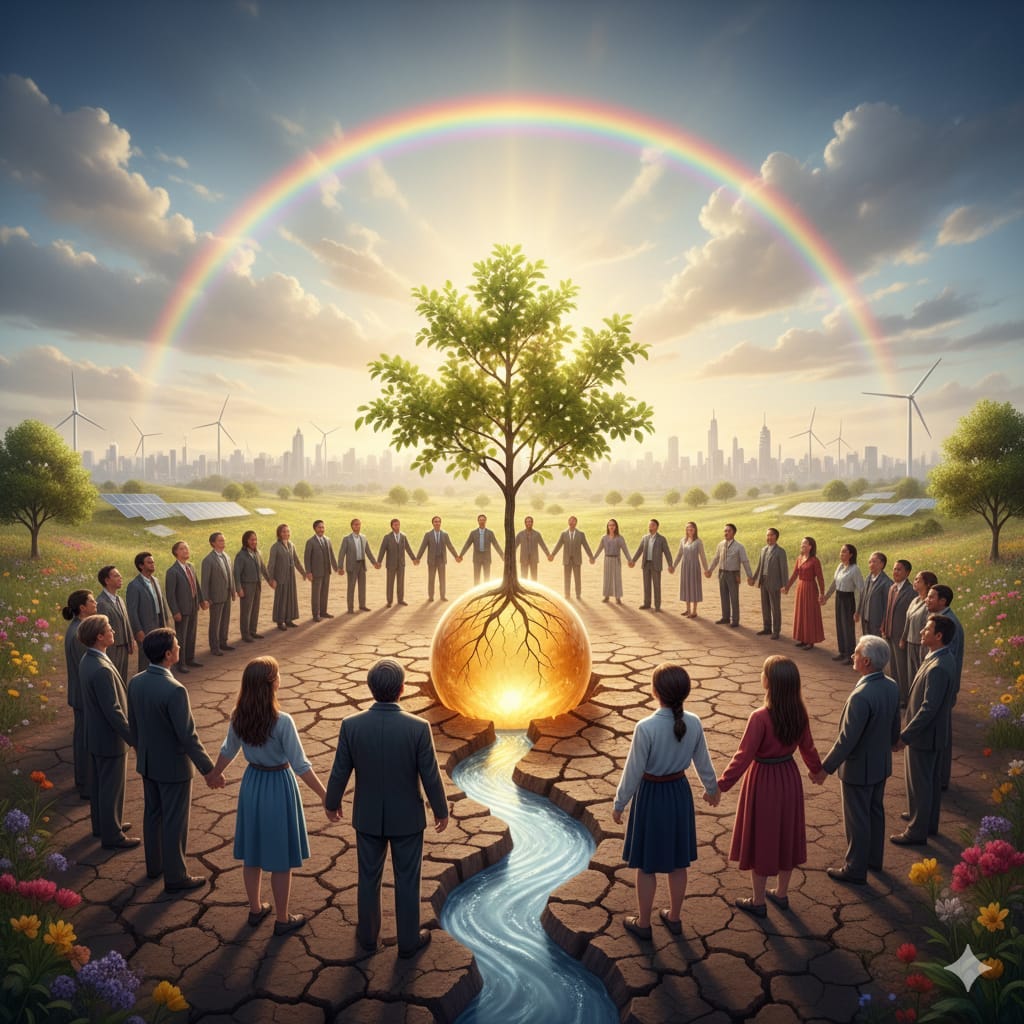
Do you ever finish scrolling through the news and feel a physical weight in your chest? A tightness in your throat? A sense of anxiety? It’s the feeling of the world’s bad news moving in and setting up camp in your nervous system. Headlines shout of war, our screens flash with arguments, and it can seem as if kindness has gone on holiday. We scroll through stories of politicians breaking promises, of communities divided, of a planet in distress. In all this noise, it’s easy to feel a heavy whisper that says, “What’s the use? Things are just getting worse.” This feeling is real. And it’s exhausting.
So where on earth can we find hope? Not the flimsy, wishful-thinking kind that waits for a hero to save us, but a real, unshakeable hope that we can feel in our hearts.
What if the most potent source of hope isn’t found by ignoring the darkness, but by looking directly at it? This is the profound, counter-intuitive starting point of Buddhism. It doesn’t ask us to ignore the pain of the world. Instead, it hands us a flashlight and shows us how to find a spring of fresh water within ourselves, even in the driest desert.
We often think of hope as being like a weather forecast. We look at the gloomy predictions and hope for a sunny day tomorrow. But when the storm continues, our hope washes away. Buddhist teaching offers a different view. Hope isn’t about predicting a better future; it’s about trusting your ability to participate in the present moment, no matter how difficult it is. The Buddha taught that life inherently involves dukkha, a word often translated as suffering, but which really means something more like unease, stress, or things just not being quite right. The news cycle is a perfect, loud example of dukkha. Accepting this is not pessimistic; it’s the first step to freedom. It’s like realising that the wind will always blow, sometimes gently, sometimes fiercely. You can’t control the direction or strength of the wind, but you can learn to adjust your sails. In this way, hope becomes your compass, guiding you through whatever comes your way. It’s the unshakeable confidence that you can learn to navigate the wind without being blown over.
“Become hope in dark times.”
Imagine your mind is a garden. The bad news, the angry comments, the fear, these are weeds. They will always blow in from outside. The problem isn’t that the weeds exist; it’s if we water them, let them take over, and forget that we are the gardeners.
A powerful and practical way to tend your garden is through mindfulness. This isn’t a complicated spiritual practice; it’s simply the act of paying attention to your present experience. The next time you read bad news and feel that familiar knot in your stomach, try this. Instead of immediately sharing it or diving into the angry comments, just stop. Take three conscious breaths. Feel the air entering and leaving your body. Notice the tension in your shoulders. Acknowledge the feeling: “Ah, this is anxiety,” or “This is sadness.” Just name it.
In that small pause, something magical happens. You create a space between the external event and your internal reaction. You are no longer just a victim of the news; you are an observer of your own mind. This space is where your power lies. It is the very seed of hope.
It isn’t a passive thing you store in a box. It’s a verb. It’s something you do. The Buddhist teaching of karma is often misunderstood as fate. Really, it means something much more hopeful: our intentional actions shape our world. Every thought, word, and deed is a seed planted.
In a world that feels selfish, the most radical act of hope is to be generous. Imagine you’re in a coffee shop. The person ahead of you is snapping at the barista. The air turns sour. You feel the urge to add an eyeroll to the collective frustration. But then you remember your wish to be hopeful. You take a breath. When it’s your turn, you look the tired barista in the eye, smile, and say, “Hope the rest of your day gets better.” You see their shoulders drop just a millimetre. The energy shifts. You didn’t stop a war, but you patched a tiny crack in the universe. That is hope as a verb.
You feel despair about climate change, a problem too big for one person. Hopelessness says, “I can’t do anything.” Hope says, “I will plant a bee-friendly plant on my balcony,” or “I will pick up three pieces of litter on my walk today.” You are actively tending your small corner of the world. These actions are tiny. They won’t make the nightly news. But like countless raindrops filling a lake, they are what truly change the atmosphere.
“Your small positive contributions matter.”
Another profound source of hope is the idea of non-attachment, especially non-attachment to outcomes. We often tie our hope to a specific result: “I will only be happy if this politician wins,” or “The world will only be good if everyone agrees with me.” This is a recipe for disappointment, because the world is constantly changing and rarely follows our personal script.
Hope flourishes when we do our best and then let go of demanding a particular result. It’s like being a gardener. You can plant the seed, water it, and give it sunlight, but you cannot pull on the sprout to make it grow faster. You have to trust the process. Think of one small thing you can do this week to make your community slightly better. Maybe it’s volunteering for an hour, writing a kind note to a friend, or simply consuming less negative media. Do it with full, generous intention. Then, consciously release your grip on what happens next. You have done your part. You have added a drop of goodness to the world. Trust that the world will receive it. This doesn’t mean you don’t care; it means you free yourself from the exhausting burden of trying to control the uncontrollable. There is incredible lightness and hope in that freedom.
To make this concrete, try this for one week: keep a ‘Goodness Log.’ At the end of each day, write down one act of kindness you witnessed, one moment of beauty you noticed, and one small, positive action you took. This isn’t about ignoring reality; it’s about retraining your attention to see the full picture. Within a week, you’ll have tangible proof that goodness is not extinct.
When the world seems full of hate, our attention is like a spotlight, fixated on the loudest, angriest voices. But if we shift our gaze, we begin to see countless points of light, like stars emerging at dusk. All over the world, right now, people are performing quiet acts of courage and kindness. Your mission, should you choose to accept it, is to become a detective of goodness. Look for these moments. Savor them. And, most importantly, become one of those points of light yourself.
The commotion of the world won’t fade away. The turmoil continues. Yet, you possess the ability to bring light. You are a source of hope. This journey doesn’t require a flawless, unreachable optimism. Rather, it encourages you to nurture a strong, enduring hope. Building it gradually through mindful breaths and small, meaningful actions each day.
You don’t have to single-handedly save the world. You just have to tend your corner of it with fierce and tender care. Start now. Take a breath. Look for one moment of goodness. Perform one tiny, unseen act of kindness. This is how we become hope.
If you would like to become a supporter of my work, such as podcasts, blogs, videos and guided meditation practices, please visit here . You can support for as little as $2 a month.
Realistic advice for turbulent times.
What a wonderful article, it felt like a warm cup of hot chocolate on a freezing day. 🧡 Thank you for writing it, I will save it, read it each week and share it with my friends to help them escape the moving sands of hopelessness.😊