

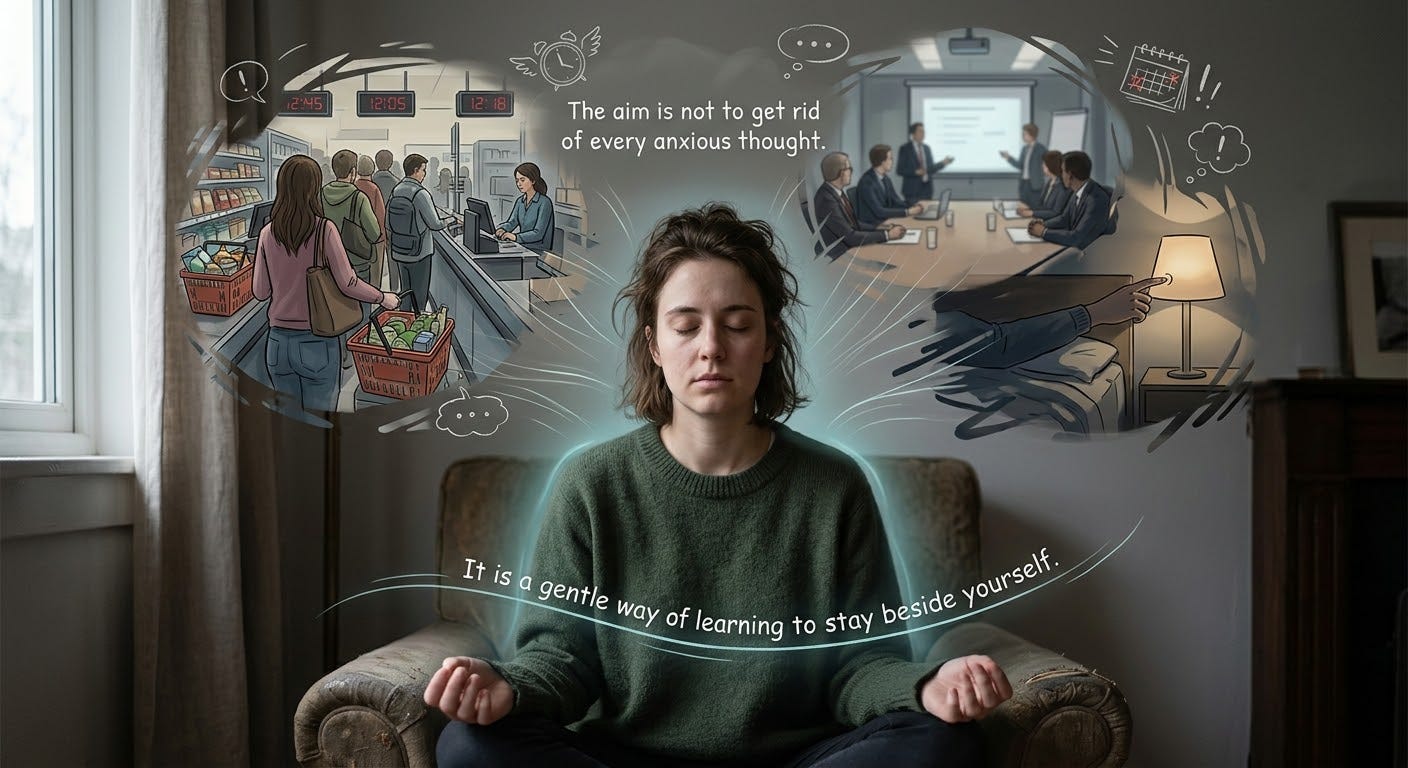
A racing mind rarely waits for a convenient moment. It may arrive in the supermarket queue, before an important meeting, or just as you turn out the light. When this happens, meditation can sound like one more thing to do well. But anxiety meditation for beginners is not about forcing your mind to be empty or pretending that everything is fine. It is a gentle way of learning to stay beside yourself when life feels difficult.
The aim is not to get rid of every anxious thought. Thoughts are part of being human. The practice is to notice what is happening with greater steadiness, soften the struggle around it, and choose your next step with a little more clarity.
What meditation can offer an anxious mind
Anxiety often pulls attention into the future. Your mind starts scanning for what could go wrong, rehearsing conversations, or searching for certainty that cannot yet be found. Your body may join in with a tight chest, shallow breathing, a restless stomach, or tense shoulders.
Meditation brings attention back to something immediate: the feeling of your feet on the floor, the movement of one breath, or the sounds in the room. This does not make a genuine problem disappear. It can, however, create a little space between you and the alarm in your mind. In that space, you may discover that you have choices.
From a Buddhist perspective, this is an act of compassion. Rather than treating anxiety as an enemy to defeat, we learn to meet our experience with kindness and wise attention. Compassion does not mean accepting harmful circumstances or giving up on change. It means you do not have to add self-criticism to an already hard moment.
Meditation is most helpful when it becomes a regular skill, not only an emergency measure. A few minutes practised gently each day can make it easier to remember the practice when pressure rises.
Anxiety meditation for beginners: begin with safety
If sitting still makes your anxiety feel stronger, that is useful information, not a failure. Some people find a closed-eye meditation calming; others feel more settled with their eyes open, looking softly at a fixed point. You may prefer to sit in a chair, stand by a window, or walk slowly in a familiar room.
Give yourself permission to adapt. Meditation is not a test of endurance. A practice that leaves you feeling overwhelmed is not necessarily the right practice for that moment.
Start with two to five minutes. Choose a time when the day is relatively quiet, perhaps after making tea, before opening your laptop, or after brushing your teeth in the evening. Consistency matters more than length. Ten uncomfortable minutes are less valuable than three minutes you can approach with willingness tomorrow.
It can also help to decide in advance how you will finish. You might open your eyes fully, name five things you can see, stretch your hands, and return to an ordinary activity. A clear ending reminds the nervous system that you are here, in the present, and able to care for yourself.
A five-minute grounding practice
Settle into a position that feels supported. Let both feet meet the floor if you are sitting. Keep your eyes open or closed, whichever feels kinder.
First, notice three points of contact: your feet against the ground, your body against the chair, and your hands resting in your lap. There is no need to change anything. Simply recognise that you are being held by the chair and supported by the floor.
Now bring your attention to the breath. Do not try to take a deep breath if that feels uncomfortable. Instead, notice one ordinary inhale and one ordinary exhale. You may feel the breath at the nostrils, in the chest, or in the abdomen. Choose the place that is easiest to sense.
When thoughts pull you away, quietly acknowledge them: “thinking”, “worrying”, or “planning”. Then return to one physical sensation, such as the feet on the floor. This returning is the practice. It is not a sign that you are doing meditation badly.
After a few breaths, place a hand over your heart or on your arm, if that feels welcome. Silently offer yourself a simple phrase: “May I be safe. May I be at ease. May I meet this moment with kindness.” These are traditional loving-kindness intentions, offered not as magic words but as a new direction for the heart.
Before you finish, widen your attention. Notice the room around you, the sounds nearby, and the steadiness beneath you. Take your time before moving on.
When the breath is not the best anchor
Breath meditation is widely taught, but it is not right for everyone at every time. For some people, focusing closely on breathing can increase panic, especially if anxiety already involves fear about physical sensations. If this happens, move your attention outwards rather than pushing through.
Try listening to sounds without naming them as good or bad. Feel the texture of a mug in your hands. Notice the colours and shapes around you. Walk slowly and pay attention to the feeling of each foot meeting the ground. These are all forms of mindful awareness.
The principle is simple: choose an anchor that helps you feel more present, not more trapped inside your distress. There is wisdom in adjusting the practice to your needs.
What to do when anxious thoughts keep returning
Beginners often assume meditation should produce a quiet mind. Yet the anxious mind may become especially loud when you first sit down, because you have finally stopped running from it. This can feel discouraging, but it is common.
Rather than arguing with every thought, try naming its pattern. You may notice “catastrophising”, “replaying”, “what if”, or “trying to solve”. Naming creates gentle distance. You are not the thought itself; you are the person noticing that the thought has appeared.
Then return to your chosen anchor without demanding instant relief. This is where equanimity becomes practical. Equanimity is not indifference. It is the capacity to remain balanced in the presence of changing experiences. An anxious thought may be here now, but it does not have to decide what you do next.
If the mind is particularly busy, make the practice more active. Count five slow steps as you walk. Hold a cool glass of water. Write down the single worry that is circling, then ask, “Is there one kind and practical action I can take today?” Meditation and sensible action work well together.
Make kindness part of the habit
Many people approach anxiety with an inner voice that is sharp and demanding: “I should be over this.” “Why can’t I cope?” “I am making a mess of everything.” That voice tends to tighten the very state you are trying to ease.
A compassion-based meditation offers another response. When you notice anxiety, try speaking inwardly as you would to someone you care about: “This is hard right now.” “I do not have to handle it perfectly.” “May I give myself the support I need.”
At first, these phrases may feel unfamiliar or even unconvincing. That is all right. You are not required to manufacture a particular emotion. The practice is simply to stop rehearsing hostility towards yourself. Over time, a kinder inner relationship can make it easier to recover after difficult days.
This is also why meditation should not become another productivity target. Some sessions will feel settled; others will be scattered. Both can teach you something. The measure of progress is not whether you feel serene every time you sit. It is whether you are gradually becoming more able to recognise anxiety, respond with care, and return to your life.
Know when to seek more support
Meditation can be a valuable part of anxiety care, but it is not a replacement for professional help. If anxiety is affecting sleep, work, relationships, eating, or your ability to function, speaking with a GP or qualified mental-health professional is a strong and compassionate step.
Seek prompt support if you are experiencing panic that feels unmanageable, thoughts of harming yourself, or distress connected to trauma that becomes more intense during meditation. In such moments, grounding practices, therapeutic support, and human connection may be more appropriate than sitting alone with difficult feelings.
You do not have to face it alone. Learning to care for the mind is not about becoming invulnerable. It is about discovering, one breath and one kind moment at a time, that even when anxiety visits, you can meet yourself with courage.
Visit my website The Compassion Academy today and find practical tools for anxiety, overwhelm, loneliness, anger, low life satisfaction, and emotional turmoil.