

Imagine you receive a beautiful, hand-carved wooden bowl as a gift. You love it. You use it every day. It feels solid, unique, and wholly itself—a “bowl.” Now, let’s trace its story backwards. Recently, it was a block of wood in a carpenter’s shop. Last year, that wood was part of a tree in a forest. That tree grew from a seed, nourished by soil, rain, and sunlight. A forester tended the forest, tools were used to cut the wood, a designer had an idea, a customer created a demand. The bowl exists only because of an immense, intricate web of non-bowl elements: trees, rain, skill, time, and intention. The label “bowl” is a useful shorthand, but if we search for some independent, permanent “bowl-ness” at its core, we come up empty. Its existence is relationship. Its substance is change. This, in its simplest form, is the Buddhist concept of emptiness. And far from being a bleak or abstract philosophy, it is perhaps the most practical and liberating lens through which to see our lives.
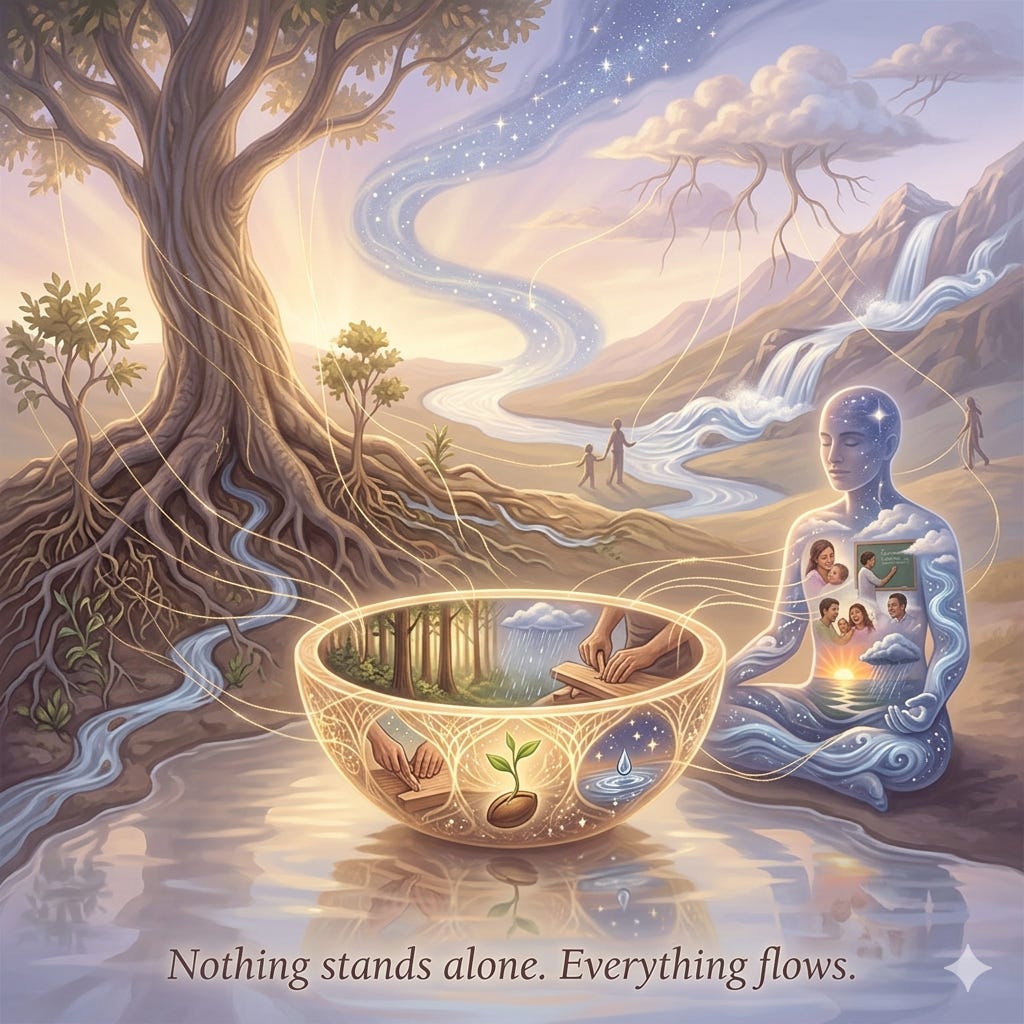
We often move through the world assuming things—and especially ourselves—possess a solid, unchanging essence. We think happiness is a thing we can own, that our personality is a fixed set of traits, and that the line between “me” and “you” is firm and real. This habit of seeing the world in solid terms is the root of a tremendous amount of our suffering. Emptiness is the gentle correction to this habit. It is not a statement that nothing exists, but that nothing exists in the way we typically think it does. Nothing stands alone. Everything is interconnected, interdependent, and in constant flux. The bowl is empty of a separate, permanent self, but it is brilliantly full of the entire universe. And so are we.
The true power of understanding emptiness is seen most clearly when we apply it to the concept we hold dearest: our own self. We operate with a deep-seated feeling of a central, enduring “me” inside—a commander in the control room of our head, a stable character in the story of our life. But if we pause and look, what do we actually find? Our physical body is made entirely of elements from the earth, air, and water, constantly exchanging atoms with the environment. Our thoughts and opinions are echoes of things our parents said, teachers taught, books proposed, and cultures reinforced. Our very name was given to us. Our emotions arise and pass like weather, dependent on causes and conditions like a good meal, a poor night’s sleep, or a friend’s kind word. Where is the solid, independent “I” in all of this? We find a flowing, ever-changing process, a river of experience. We are a verb pretending to be a noun. To see this is to see the emptiness of self.
Why is this realization so profoundly important? Because it directly treats the sickness of “stickiness” that causes our pain. Our suffering is rarely about the raw events of life themselves, but about our tight, clenched grip on how we believe those events should be. We grasp at pleasant experiences, believing they should last forever, and we suffer when they fade. We push away unpleasant experiences, believing they should never touch us, and we suffer when they arrive. Most of all, we grasp at this idea of a fixed self, believing it must be constantly defended, praised, and kept secure. Every insult feels like a crack in our foundation. Every failure feels like a permanent stain on our identity. We are like a person trying to hold a river in their hands, exhausted and heartbroken by the constant, inevitable flow.
Seeing emptiness loosens this grip. When you know the joyful moment is like a sunset—a beautiful, temporary play of light dependent on a million factors—you can savour it completely without the underlying anxiety of demanding it stay. You enjoy the sunset without shouting at the Earth to stop turning. When you know the painful moment is equally dependent and fleeting, you can face it with more space and resilience, like watching a storm cloud pass through a vast sky, rather than feeling it is the final state of the sky itself. And when you see your “self” as this flowing, interdependent process, criticism loses its existential sting. It becomes feedback about a temporary action, not a verdict on an eternal soul. You are no longer a brittle sculpture, but flexible bamboo. This is the first great gift of emptiness: freedom from the exhausting work of trying to freeze a universe that is inherently fluid.
This brings us to the second, and perhaps most beautiful, fruit of this understanding: natural, effortless compassion. If the boundary between self and other is not as solid as it appears, then your happiness and mine are not truly separate projects. When I see that you are made of the same stuff—the same need for safety, the same capacity for joy and pain, the same dependence on a web of causes—the illusion of separation softens. Your pain resonates in me not as a distant problem, but as something happening within a larger whole of which we are both parts. Helping you is no longer a lofty moral obligation; it becomes as instinctive and logical as using one hand to comfort the other when it is injured. Compassion flows not from a sense of superiority, but from a recognition of fundamental kinship. We move from “I feel sorry for you” to a deeper, more authentic “we are in this together.”
Some might worry that seeing emptiness could lead to passivity or nihilism. If nothing is solid, why do anything? Why care? This is a crucial misunderstanding. Emptiness does not drain life of meaning; it fills it with a lighter, more workable kind of meaning. Think of it like watching a gripping play at the theatre. One viewer gets utterly lost, believing the drama on stage is real. They weep real tears, feel genuine rage at the villain, and are emotionally drained. Another viewer understands it is a play—actors, scripts, sets, and lighting—and can therefore appreciate it on an even deeper level. They can admire the artistry, feel moved by the themes, and be fully present for the experience, all while knowing its inherent nature. When the curtain falls, they can stand up and walk freely into the night, without being haunted by the story. The first viewer is trapped in the show. The second is liberated by it.
This is how emptiness allows us to engage with life fully, but without the hangover. We can throw ourselves into our work, not as a desperate quest to build a permanent monument to our self-worth, but as a dynamic, creative expression in the moment. We can love deeply in our relationships, not from a need to own or be completed by another person, but from a place of celebrating a profound and fleeting confluence of two ever-changing streams. We can appreciate our possessions, like that wooden bowl, not as trophies that define us, but as temporary gatherings of the world’s beauty, to be cared for and one day let go. The joy is in the participation, not in the desperate, impossible attempt to press “pause.”
Ultimately, the concept of emptiness is a profound trade. We trade the heavy, rigid burden of permanence for the light, liberated understanding of flow. We trade the lonely fortress of a separate self for the warm, interconnected web of being. We trade the brittle story of a fixed identity for the freedom of being an unfolding mystery. It is a shift from living in a world of frozen statues, where every change is a threat, to dancing in a world of music, where every note arises and passes as part of a magnificent, ever-changing symphony.
It begins with a simple look. At a bowl. At a thought. At your own hand. Asking, “What is this really made of? Where does it come from? Can it exist alone?” In that questioning, the solid walls of our world begin to reveal themselves as the flowing, interdependent patterns they have always been. And in that seeing, there is a deep, exhaling breath—the breath of letting go into the way things actually are. That is the quiet, revolutionary freedom of emptiness.

I don’t want this to remain just an intellectual exercise, so here are three practices to help you translate this understanding into lived wisdom.
1. Practice “Parts Meditation” with Everyday Objects
One of the most straightforward ways to understand emptiness is to see that things are not the solid, singular entities we believe them to be. They are collections of parts that we label for convenience.
Pick a common object you use daily—a coffee mug, your phone, or a piece of fruit. Instead of seeing “my mug,” see its components: the handle, the cylindrical body, the glaze, the empty space inside that holds the liquid. Can you find the “mug” in any single part?
Think about where it came from. The clay from the earth, the potter who shaped it, the heat of the kiln, the truck that delivered it to the store. The mug is not a self-existent thing; it is a temporary result of countless causes and conditions.
This practice cuts through the feeling of solidity we project onto objects. If you get attached to a new mug, remember that its “newness” is just a temporary label. If you break the mug, you are less likely to get angry, because you understand it was always a fragile collection of parts destined to change.
2. Analyse the “Gap” Between Sensation and Story
We often react not to the world as it is, but to the stories we tell ourselves about it. Emptiness teaches us that our projections (the story) are empty of inherent truth; they are mental constructs.
The next time you feel a strong emotion (anger, craving, or anxiety), pause and separate the raw sensation from the narrative.
Step 1 (The Sensation): Notice the physical feeling in your body. Is it heat in your chest? Tightness in your jaw? A fluttering in your stomach? Just observe it as pure energy.
Step 2 (The Story): Notice the thoughts attached to it. “He shouldn’t have said that!” or “I need that to be happy.”
Step 3 (The Insight): See that the story is empty of intrinsic power. The story only has the power you give it. The raw sensation is just energy, which will pass naturally if you don’t fuel it with the narrative. The situation is not inherently bad or good; you are labelling it as such.
You realize that your suffering often comes from the story you superimpose on reality. This creates space between stimulus and response, allowing you to choose a wiser reaction.
3. See People as “Flows,” Not “Fixed Entities”
We often label people (including ourselves) with fixed identities: “They are annoying,” “I am shy,” “He is a bad driver.” Emptiness shows us that people are dynamic processes, constantly changing based on mood, context, and health.
When you find yourself judging someone (or yourself), consciously add a “...right now” or “...in this context” to the thought.
Change “He is so rude” to “He is acting rudely right now, probably because he is stressed.”
Change “I’m terrible at public speaking” to “I felt nervous during that presentation, in that room, with that audience.”
Try to see the person in front of you not as a fixed sculpture, but as a flowing river of moments, such as a mother, a child, a worker, a dreamer.
This is the foundation of compassion. If people were permanently and inherently “evil” or “annoying,” there would be nothing we could do. But because their negative traits arise due to causes (like pain, fear, or misunderstandings), those traits can also cease. It makes it easier to forgive others and to be kinder to yourself on bad days.
I have attached the audio of this article for those who prefer to listen.
Thank you, Yeshe, your Dharma lectures and this post make it so easy to understand the concepts. I thank you for helping me getting into Buddhism.
Really good read !