

By almost every measurable standard, life today is better than it has ever been in human history. We live longer, healthier lives with access to more food, greater comfort, and instant connection to people across the globe. Yet, paradoxically, rates of depression and loneliness are climbing, and many people feel more overwhelmed, cheated, and dissatisfied than ever before. This contradiction suggests that our struggle is not a problem with life itself, but a problem with our expectations. The core insight is simple: your brain does not report reality exactly as it is but rather reports the gap between what you expected to happen and what actually happened.
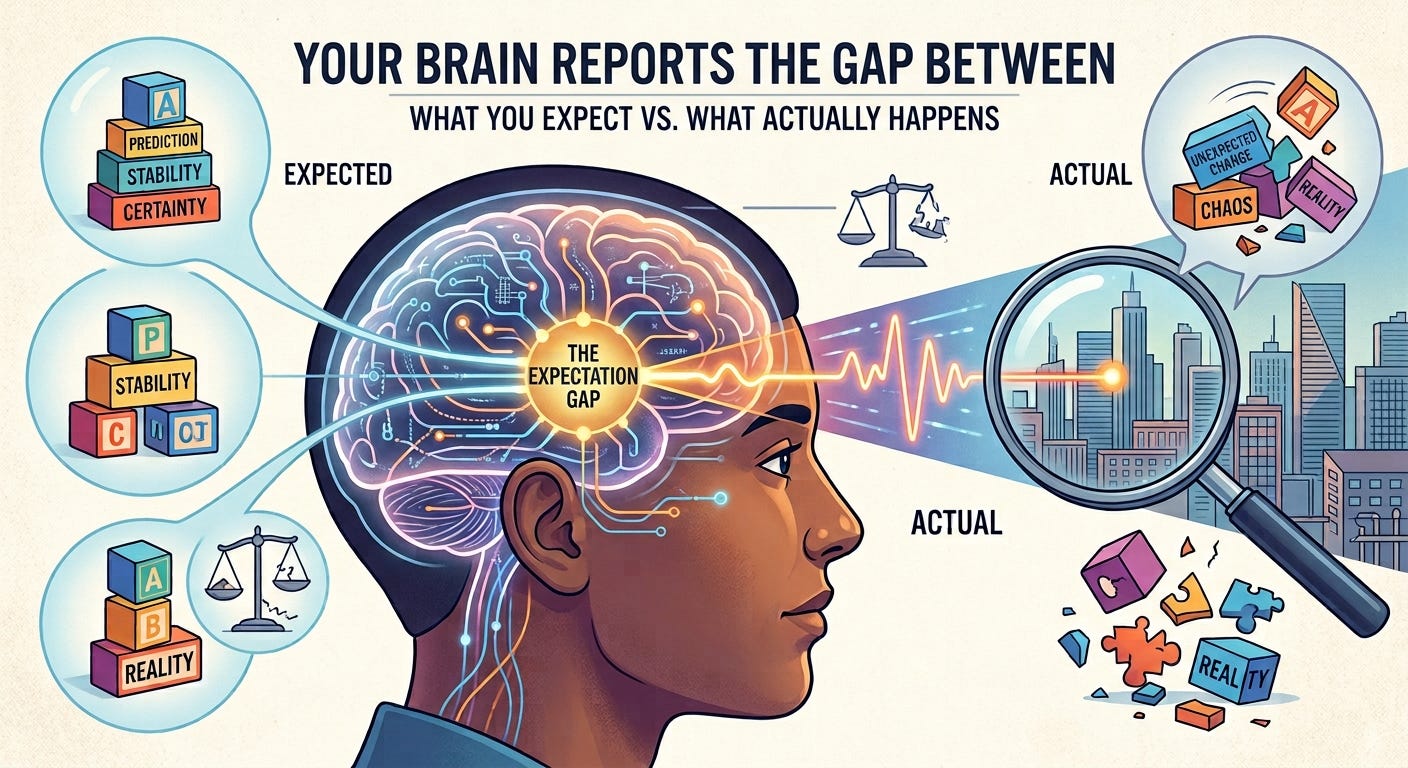
Think about losing a job. In the past, people often stayed in one job for their whole life, and changing careers was very rare. Losing a job was a huge shock to who you were, but people understood it was just a risk of the economy that could happen to anyone. Today, we are told we can change careers anytime and that our success will always go up. So, when someone loses a job or a business fails, it feels like a personal flaw. It feels like you alone failed to keep up in a world that promises everyone a chance. The job loss is the same, but because we now expect to control our future, it feels like deep personal shame instead of being a part of life. We have allowed our expectations to spiral into a territory that almost nothing can satisfy, expecting parenting to be naturally fulfilling so we feel like failures when it is exhausting, expecting relationships to be perfectly fair so we feel cheated when they are unbalanced, and expecting modern life to automatically reward our hard work so we feel wronged when it grinds us down.
This pattern repeats in countless modern scenarios. We expect our careers to provide constant meaning and rapid advancement, so when we face a mundane Tuesday of spreadsheets and emails, we feel a deep sense of emptiness rather than seeing it as a stable job that pays the bills. We expect our bodies to look like the filtered images we see on social media, so when we see normal wrinkles or cellulite in the mirror, we feel defective rather than human. We expect technology to work flawlessly, so when a website loads two seconds late or a GPS takes us on a detour, we feel a spike of rage that our ancestors, who walked days to reach a destination, never would have known. Research highlights just how powerful these expectations are in shaping our reality. In a famous study at Dartmouth, researchers put a fake scar on participants’ faces and told them the study was about how disfigurement affects social interactions. Just before the participants went out to interact with strangers, the researchers secretly removed the scar, yet the participants still walked out believing they were disfigured. Afterward, they reported that people had stared, acted uncomfortable, and treated them differently. The scar was not there, but the expectation was, and that expectation created their entire experience of reality.
This is the hidden cost of a culture focused on complaining, because every time we tell our life story as a list of what we have been denied, what we are owed, or what should be different, we train our brains to build a case against life until that is all they can see. To break this cycle, behavioural science offers practical shifts that go beyond simple positive thinking. The first step is to actively recalibrate your reference point by accepting that you were never promised a frictionless life, a perfect partner, a perfect child, or a perfectly fair world. As the Buddha noted in his First Noble Truth, life inherently involves suffering, and when you release the idea that you are owed a perfect life, ordinary moments start to look remarkable. You can practice this by engaging in “negative visualization,” a technique used by Stoic philosophers. Take a few minutes each morning to imagine losing something you take for granted, such as your health, your home, or your ability to walk. When you open your eyes and realize you still have these things, the mundane reality of your morning coffee or your commute suddenly feels like a gift rather than a boring routine. Another practice is to consciously lower the bar for daily interactions; expect the barista to be tired, expect traffic to be slow, and expect your computer to glitch. When things go smoothly, you are pleasantly surprised, and when they go poorly, you simply nod and say, “Just as expected,” robbing the event of its power to ruin your mood.
The second crucial shift is to replace narrating your struggles with serving others, recognizing that gratitude is not just a warm feeling but an action. When you shift your focus from asking what you are getting to asking what you can give, you stop living inside the gap of expectation. This can be practiced through small, deliberate acts of service that force you to engage with reality as it is. Instead of waiting for a friend to text you first to validate your friendship, send them a message asking how you can support them this week. Instead of waiting for your workplace to recognize your efforts, look for a colleague who is struggling and offer specific help without expecting credit. You might try a “service audit” where you track how many times a day you think about what you deserve versus how many times you think about what you can contribute. When you catch yourself feeling entitled to a clean house, a quiet evening, or perfect weather, immediately pivot to a question of service: “Who can I help right now?” or “What small task can I complete to make someone else’s life easier?” This shifts your brain from a passive consumer of life, constantly measuring inputs and outputs, to an active participant who creates value regardless of circumstances.
The world has not failed your generation; instead, your generation may have inherited the most inflated set of expectations in human history. The antidote is not to lower your ambitions or settle for less, but to learn to be genuinely surprised and grateful for what is already here. By practicing negative visualization to appreciate what you have, lowering your expectations for daily friction to reduce anger, and shifting your focus from entitlement to service, you can find contentment not by changing the world, but by changing how you see it. When you stop demanding that reality conform to your script, you finally become free to enjoy the show that is actually playing out in front of you.
You can listen to the article below.
I've been saying for a while now, in my undoubtedly cynical manner, that the key to a happy life is 'expectation management'
Thanks for laying this out so clearly and compassionately.
Thanks so much fot the wise words. For me, I try to focus on meeting the world not as how I expect it to be but as it is. Also a healthy grattitude practice helps with keeping me grounded.